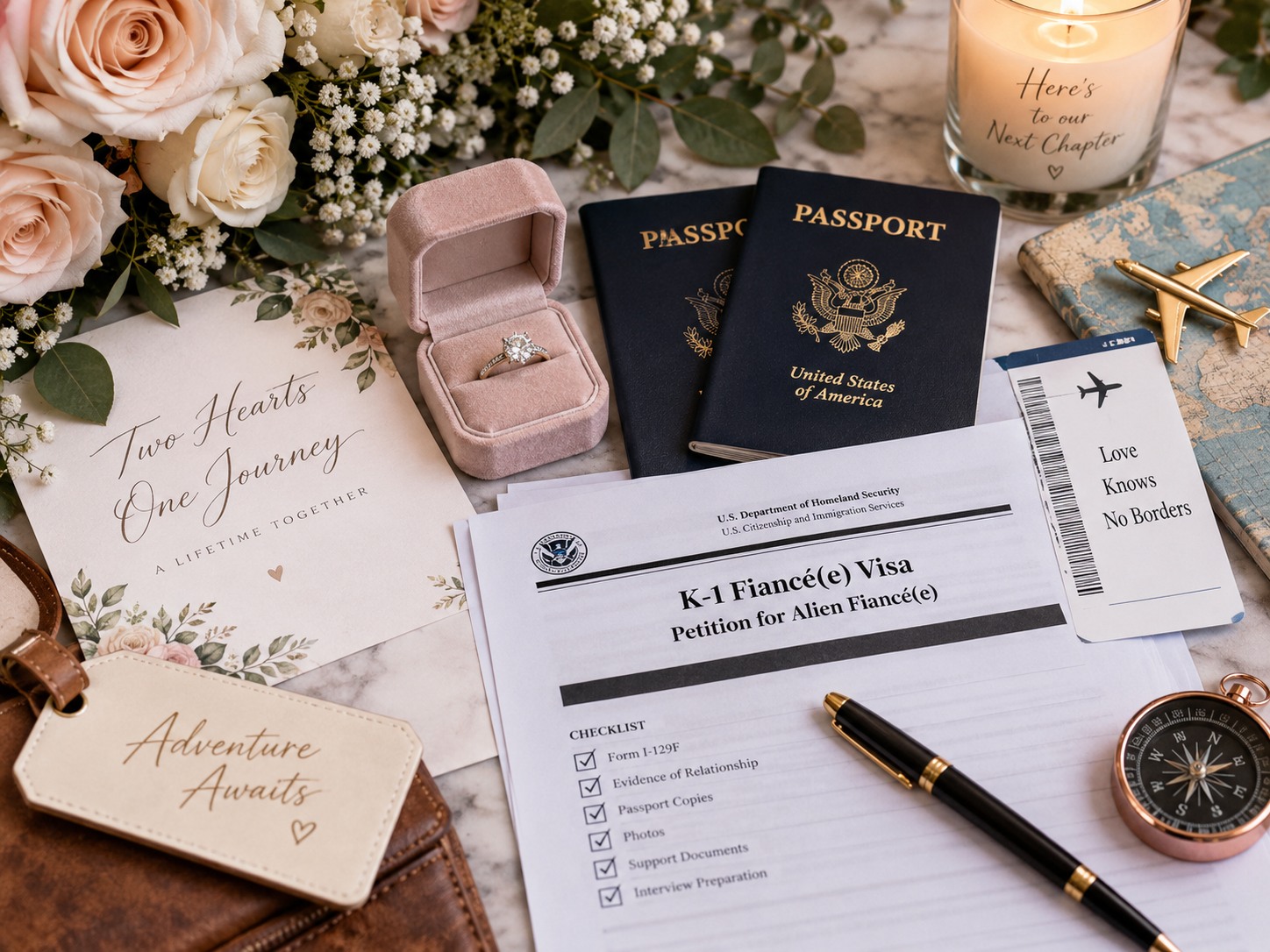
Overview: What the K-1 Visa Is and Who It's For
The K-1 nonimmigrant visa is a single-purpose travel document that allows the foreign-national fiancé(e) of a U.S. citizen to enter the United States solely to marry the petitioning citizen within 90 days of arrival. It is one of the most common family-based pathways to lawful permanent residence, and it is also one of the most heavily scrutinized — both because the visa is conditioned on a future event (the marriage) and because it requires consular officers and USCIS officers to evaluate the bona fides of a relationship that has not yet been formalized.
For couples who already have a confirmed plan to wed and who can document a genuine relationship, the K-1 process is well-mapped and predictable. For couples whose circumstances are unusual — significant age gaps, brief in-person meetings, prior denials, criminal history on either side, or a previously divorced foreign-national fiancé(e) — the path requires careful preparation. This guide walks through the K-1 from petition to green card.
Eligibility Requirements
Before any paperwork is filed, both parties must satisfy the K-1's threshold requirements:
- The petitioner must be a U.S. citizen. Lawful permanent residents (green card holders) cannot file K-1 petitions; the fiancé visa exists only for U.S. citizens.
- Both parties must be free to marry. Any prior marriage on either side must be legally terminated by divorce, annulment, or death of the prior spouse, with documentation in hand at the time of filing.
- The couple must intend to marry within 90 days of the foreign national's entry on the K-1 visa. The 90-day clock is hard — there is no extension.
- The couple must have met in person within the two years immediately before filing the I-129F. Limited waivers exist for couples whose religion or culture prohibits an in-person meeting before marriage, and for couples for whom a meeting would impose extreme hardship. Both waivers are narrowly granted.
- The foreign-national fiancé(e) must be admissible to the United States. Past immigration violations, certain criminal convictions, and prior misrepresentations can trigger inadmissibility, which may or may not be waivable depending on the ground.
The Three-Stage Process
Stage 1: Form I-129F Filed With USCIS
The U.S. citizen petitioner files Form I-129F, Petition for Alien Fiancé(e), with USCIS. Required supporting evidence typically includes:
- Proof of the petitioner's U.S. citizenship (passport, birth certificate, naturalization certificate, or Consular Report of Birth Abroad)
- Proof that any prior marriages on either side have been legally terminated
- A signed statement of intent to marry within 90 days of entry, from each party
- Documentation of an in-person meeting within the past two years (boarding passes, passport stamps, hotel receipts, photographs of the trip)
- Evidence of an ongoing, genuine relationship — communications, photographs together, joint travel, evidence of family or friends meeting the partner
- Two passport-style photographs of each party
- Information about any criminal history of the petitioner under the International Marriage Broker Regulation Act (IMBRA), regardless of relevance
Approval times for I-129F petitions vary substantially by service center and case complexity; recent processing has typically run several months to over a year. Petitioners can check current processing times on the USCIS website or in our Processing Times resource.
Stage 2: National Visa Center and Consular Processing
Once USCIS approves the I-129F, the petition is forwarded to the Department of State's National Visa Center (NVC) and then on to the U.S. embassy or consulate in the country where the foreign-national fiancé(e) lives. The fiancé(e) receives instructions for completing the DS-160 nonimmigrant visa application, scheduling the medical examination with a panel physician, and attending the visa interview.
At the interview, the consular officer evaluates the bona fides of the relationship and the foreign national's admissibility. Strong applications include organized documentation of the relationship, financial support evidence (Form I-134 Affidavit of Support and the petitioner's recent tax returns, pay stubs, and proof of employment), and complete civil documents (birth certificates, police certificates, divorce decrees from any prior marriages). Children of the foreign-national fiancé(e) under 21 may apply for K-2 derivative visas to accompany or follow to join.
Stage 3: Entry, Marriage, and Adjustment of Status
After visa issuance, the K-1 has a six-month validity period for use. Upon admission to the United States, the foreign national has 90 days to marry the petitioner. Any other marriage during that 90-day window will not satisfy the K-1 condition; the marriage must be to the petitioning U.S. citizen.
After the marriage, the spouse files Form I-485, Application to Register Permanent Residence or Adjust Status, with USCIS. This is where the K-1 holder becomes a conditional permanent resident (CR-1) if the marriage is less than two years old at the time of approval, or a permanent resident (IR-1) if the marriage is older than two years (rare in K-1 timelines). Concurrently filed are Form I-765 (employment authorization) and Form I-131 (advance parole for travel).
The conditional resident must file Form I-751, Petition to Remove Conditions on Residence, in the 90-day window before the second anniversary of becoming a permanent resident. Failure to file timely results in loss of status.
Common Pitfalls — and How to Avoid Them
- Inadequate evidence of the relationship. A handful of selfies is rarely enough. Build a documentary file from the start: chat logs, video call screenshots, joint travel records, evidence of family integration, financial commingling where applicable.
- Outdated divorce documentation. Foreign divorce decrees must comply with the law of the country where they were issued and must be properly translated. Decrees that lack the formality required by the consulate are a common reason for delays.
- Letting the 90-day window lapse. The 90-day rule is unforgiving. If the marriage cannot occur within 90 days, the foreign national must depart the U.S. and pursue a different path (typically a CR-1/IR-1 spousal immigrant visa filed after marriage).
- Underestimating the affidavit of support. The petitioner must demonstrate the financial means to support the fiancé(e) at 100% of the federal poverty guidelines (or 125% at the I-864 stage during adjustment). Joint sponsors are available where the petitioner's income alone is insufficient.
- Travel during pending I-485. Departing the U.S. without an approved Form I-131 advance parole document during pending adjustment of status risks abandonment of the application.
K-1 vs. Spousal Immigrant Visa (CR-1 / IR-1): Which Is Right for You?
For couples not yet married, the comparison is straightforward: a K-1 brings the foreign national to the U.S. faster on a nonimmigrant visa, and the marriage occurs in the United States. A CR-1 or IR-1 immigrant visa requires marriage abroad first, then a longer petition and consular processing timeline, but the foreign national arrives as a permanent resident on day one and does not need to file separate adjustment of status, employment authorization, or advance parole applications. CR-1/IR-1 timelines historically can run longer at the front end but compress significantly at the back end. Total cost is comparable.
For couples who would prefer to marry in the foreign national's home country and bring family there, CR-1/IR-1 may be the better path. For couples who want the wedding in the United States and value getting the foreign national here sooner, K-1 typically wins.
How Cann Legal Group Helps

K-1 cases turn on documentation. Couples whose I-129F is properly assembled — with relationship evidence organized, civil documents authenticated, and inadmissibility issues identified and addressed before filing — see materially smoother adjudication than couples who file on their own and discover problems at the consular interview. Cann Legal Group has handled K-1 cases from countries on six continents and is familiar with the specific evidentiary expectations of major U.S. consulates. We are happy to discuss your circumstances in a confidential consultation.
To schedule a consultation, contact us at (410) 988-0123 or info@cannlaw.com.