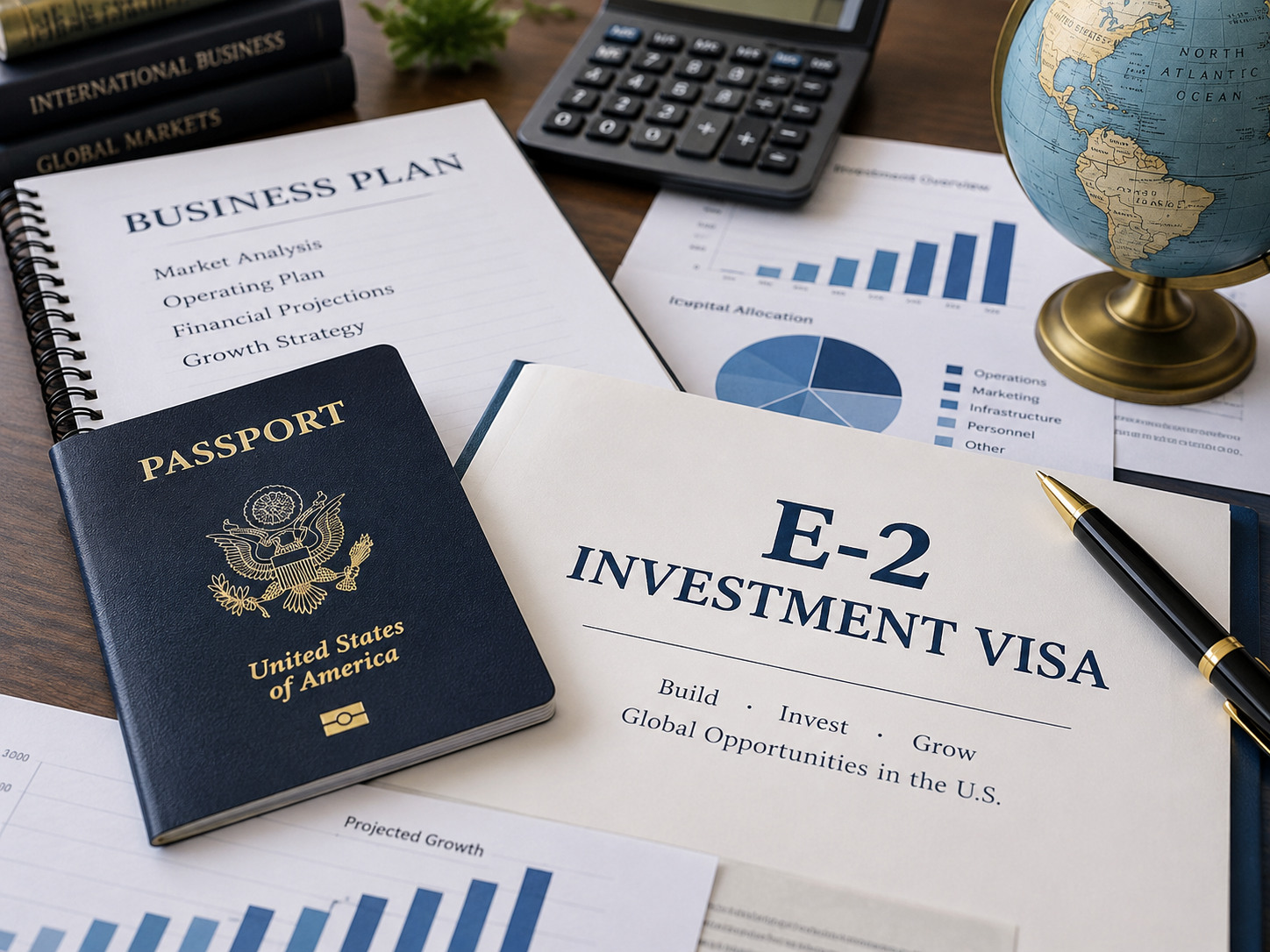
What the E-2 Visa Is — and Why Investors Use It
The E-2 Treaty Investor visa is a nonimmigrant visa that allows nationals of countries with which the United States maintains a qualifying treaty of commerce and navigation to enter the U.S. to develop and direct the operations of a business in which they have invested a substantial amount of capital. It is one of the most flexible and popular routes for entrepreneurs, family-owned businesses, and franchise operators who want to live in the United States while running a U.S. enterprise.

Unlike the EB-5 immigrant investor program, the E-2 is a nonimmigrant classification — it does not lead directly to a green card. But it offers something EB-5 does not: a relatively fast timeline, no minimum investment threshold fixed by statute, and the ability to renew indefinitely so long as the underlying business remains operational and the investor continues to qualify. For many investors with means well below the $800,000 EB-5 minimum, E-2 is the more practical option.
The Five Core Requirements
1. Treaty Country Nationality
The investor (or, in the case of a corporate entity, owners holding at least 50% of the company) must be a national of a country with which the United States has a qualifying treaty. The list of treaty countries is published by the Department of State and includes most of Western Europe, the United Kingdom, Canada, Mexico, Japan, South Korea, Argentina, Colombia, the Philippines, Australia, and many others. Notable absences include India, China, and Brazil — citizens of those countries are generally not eligible for E-2.
For applicants whose home country is not on the treaty list, naturalization in a treaty country is sometimes a viable long-term path to E-2 eligibility, though it requires careful planning.
2. Substantial Investment
The investment must be "substantial" in proportion to the total cost of either purchasing an established business or creating a new one. The Department of State applies an "inverted sliding scale": for a small business, the investor must demonstrate a higher percentage of total cost; for larger enterprises, a lower percentage may be acceptable. There is no statutory minimum, but practical experience suggests investments below roughly $100,000–$150,000 face heightened scrutiny, and investments below $50,000 are rarely approved unless the business model genuinely requires very little capital.
The investment must be the investor's own funds, lawfully obtained, and traceable through documentation. Loans secured by the investor's personal assets count; loans secured by the business's own assets do not. Sources of funds must be documented thoroughly — bank statements, sale-of-property records, gift letters with supporting documentation of the donor's source of funds, and tax returns are all standard.
3. The Investment Must Be At Risk
The investor must have placed the funds at risk of partial or total loss. Funds sitting in an escrow account, contingent on visa approval, generally do not satisfy this requirement on their own — though escrow arrangements with appropriate release language can sometimes work. Demonstrable evidence of irrevocable commitment of capital is essential: leases signed, equipment purchased, employees hired, marketing launched, inventory acquired.
4. The Enterprise Must Be Bona Fide and Not Marginal
"Bona fide" means a real, operating commercial enterprise — not a paper company, not a passive investment vehicle, not a sham. "Not marginal" means the business must have the present or future capacity to generate more than enough income to provide a minimal living for the investor and family. A business that exists only to support the investor's own household income generally fails the marginality test, although the regulations allow up to five years for a new enterprise to demonstrate non-marginality through a credible business plan.
Strong applications include a five-year business plan with realistic financial projections, market analysis, hiring plan, and cash flow forecasts. Marginal-looking businesses (single-operator service businesses, for example) require especially careful presentation.
5. The Investor Must Develop and Direct the Enterprise
The E-2 investor must own at least 50% of the enterprise or hold operational control through a position such as managing partner or executive officer. Passive investors cannot qualify as E-2 principal applicants. Employees of an E-2-qualifying enterprise may obtain E-2 employee visas if they hold executive, supervisory, or specialized-skills positions and share the same nationality as the principal investor.
Application Process: Consular Processing vs. Change of Status
An applicant outside the United States files Form DS-160 and applies for the E-2 visa at a U.S. consulate or embassy abroad. Most consulates require a comprehensive E-2 application package, including the business plan, source-of-funds documentation, evidence of investment, and proof of treaty-country nationality. Consular processing times vary widely — some posts schedule E-2 interviews within weeks; others have wait times of several months.
An applicant already in the U.S. in another nonimmigrant status may file Form I-129 with USCIS to request a change of status to E-2. This route avoids consular processing but does not produce a visa stamp; the applicant must still obtain a visa at a consulate before any international travel and re-entry. USCIS adjudication times are generally longer than consular processing, but premium processing is available for an additional fee.
E-2 Spouses and Dependents
The principal investor's spouse and unmarried children under 21 are eligible for E-2 dependent visas. E-2 spouses are automatically authorized to work in the United States — they do not need a separate Form I-765 employment authorization document, though obtaining one can simplify employer onboarding. E-2 children may attend school but are not work-authorized.
Duration, Renewals, and the Path Forward
E-2 visa stamps are typically issued for up to five years (varies by treaty country reciprocity). Each entry into the United States grants a two-year period of authorized stay, renewable upon departure and re-entry on a valid visa. Extensions of stay through Form I-129 with USCIS are also available, in two-year increments, indefinitely — so long as the underlying business continues to qualify.
Because the E-2 does not lead directly to a green card, investors with permanent residence goals should consider longer-term options early. Common bridges include:
- EB-5 Immigrant Investor Program. If the E-2 business grows to meet EB-5 job creation and investment thresholds, an EB-5 petition may follow.
- EB-1C Multinational Manager. For investors who have built up a parent or affiliate operation abroad and have served in an executive or managerial capacity, EB-1C is a powerful route to a green card without per-country backlog.
- EB-2 National Interest Waiver. For investors whose business serves a substantial U.S. national interest (technology, public health, energy, etc.), the NIW can avoid PERM labor certification.
- Family-based sponsorship. If the investor's spouse or child becomes a U.S. citizen, family-based options open up.
E-2 vs. EB-5: A Quick Comparison
The two investor categories are often confused, but they serve quite different purposes.
- E-2 (nonimmigrant). No fixed minimum investment. Faster timeline (weeks to months). Renewable indefinitely. Does not lead directly to a green card. Limited to treaty-country nationals. Spouse work-authorized.
- EB-5 (immigrant). $800,000 minimum (Targeted Employment Area) or $1,050,000 (non-TEA) as of current law. Longer timeline (often 2+ years to conditional residence). Leads to a green card and ultimately citizenship. Open to nationals of any country, though country-specific backlogs apply. Job creation requirement: 10 full-time U.S. workers.
For most entrepreneur-investors with capital between $100,000 and $750,000 who want to live and operate in the U.S., E-2 is the more efficient and flexible choice. For investors specifically seeking permanent residence and willing to commit larger capital, EB-5 is often more appropriate.
Common Pitfalls
- Source-of-funds gaps. Even a small unexplained transfer in the funds-tracing chain can derail an otherwise strong application. Documentation must be comprehensive.
- Marginal businesses dressed up as substantial. Consular officers see thousands of E-2 applications and recognize aspirational projections that lack realistic underpinning.
- Incomplete control documentation. Where ownership is shared or held through holding companies, the 50%-or-control documentation must be airtight.
- Treating the E-2 as a green card path by default. It is not. Plan parallel routes early.
How Cann Legal Group Helps
Successful E-2 cases are built well before the visa interview — at the business plan stage, the funds-tracing stage, the entity-formation stage. Cann Legal Group has guided E-2 investors from countries across the treaty list through new-business, acquired-business, and franchise-based applications. Our practice includes the related work of forming the U.S. entity, negotiating purchase agreements where applicable, and coordinating with accountants on financial projections that hold up under consular scrutiny.
To discuss whether the E-2 visa is right for your investment, contact us at (410) 988-0123 or information@cannlaw.com.